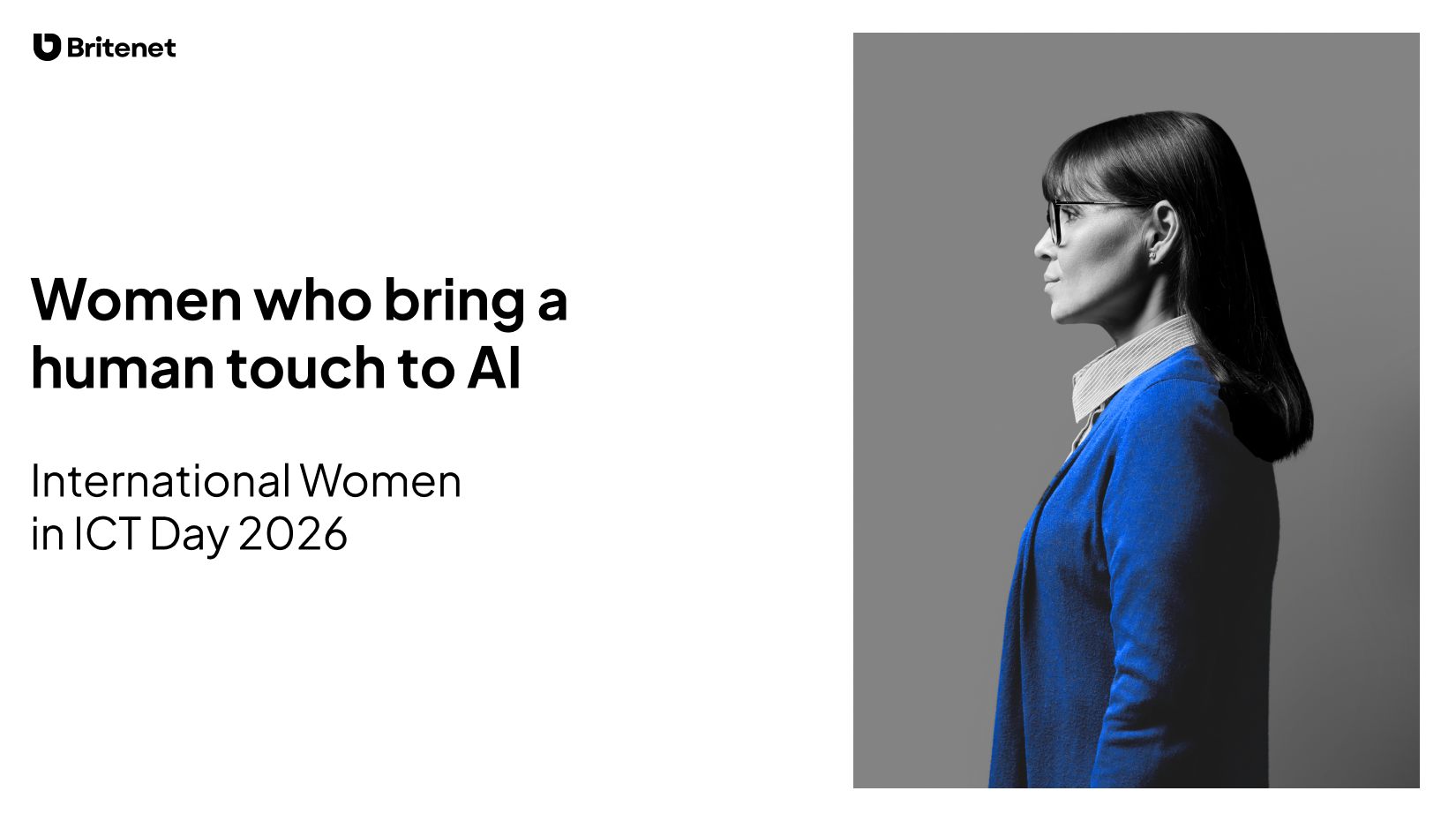
On 23 April, we celebrate International Girls in ICT Day 2026 – a global initiative aimed at highlighting the role of women in the technology sector. The theme of this year’s event is ‘AI for Development: Girls shaping the digital future’, and it aims to support women in becoming leaders in the fields of artificial intelligence, robotics, and programming.
To mark the occasion, we asked the women behind Britenet for their views on the development of artificial intelligence, what role they see for women in the world of new technologies, and what impact AI has on their daily work and lives. Their answers show that the future of ICT is not just about innovation, but also about empathy, awareness and a perspective that gives technology a more human dimension.
Women’s attentiveness is changing the way AI is designed
In your opinion, what does a woman’s touch bring to projects involving artificial intelligence?
I think that a woman’s touch brings, above all, attentiveness and a very practical perspective to AI projects. As an analyst, I often look not only at whether something works, but also whether it makes sense, whether it meets a real need, and whether the user will feel like closing it after just three clicks.
On top of that, there’s precision, asking the right questions, and the ability to take a broader view. In AI, it’s easy to get carried away by the technology, but someone still needs to ask: ‘Great, but how will this actually help people?’. And I get the impression that women are often particularly good at picking up on precisely that. And let’s not kid ourselves – if something can be clarified, organised or improved, it’s very often us who notice it.
Joanna Gepner – Business Analyst Leader
If you could create a single AI tool to solve a specific social or business problem, what would it be?
I’d create an AI to save people from complicated emails, documents and messages that make you want to have a cup of coffee first before even trying to work out what on earth they’re about. Such a tool would translate everything into simple language and immediately say: ‘this is important’, ‘this can be put off until later’ or ‘unfortunately, you do need to reply to this’. It would also be useful to have a function for politely replying to emails – especially when we’re formulating a much less diplomatic reply in our heads than the one we should actually send. I think such an AI would save people a lot of time, stress and a few unnecessary sighs throughout the day.
If you had to name one thing in your department that AI has ‘improved’ the most, what would it be?
I’d say, first and foremost, the speed at which we can work with information. These days, we can check things, organise them, draw conclusions or prepare a first draft much more quickly. That doesn’t mean that AI thinks for us, but it certainly helps us move from chaos to concrete results much faster, and in analytical work, that’s really valuable.
Women’s skills are shaping a new era in the world of technology
How does a female perspective enrich the projects we carry out at Britenet?
I believe that women are fully-fledged professionals and leaders, not because they belong to a different gender, but because they possess knowledge, talent and experience. They do not need to justify their presence in the industry or bring any particular ‘feminine’ value to the table, as their contribution to a project stems from their competence and the quality of their work.
Ewa Dziewiątkowska – Senior Angular Developer
If you could create a single AI tool to solve a specific social or business problem, what would it be?
No doubt many people would benefit from AI acting as an everyday assistant. Such a system would take on some of the daily chores: it would book doctor’s appointments, anticipate children’s needs and, based on an analysis of their data, suggest books, activities or the right wardrobe for the coming season. It would plan grocery shopping according to demand or even order it itself, pay bills, and so on. In doing so, it would relieve people of some of the burden of constantly having to remember and think about everything at once.
Technological development alongside the human perspective
For me, being a woman in IT means…
For me, being a woman in IT means combining technical expertise with a focus on people – whether they’re users, team members or the business context. It also means having the courage to ask questions about the purpose of what we’re doing and for whom, before we move on to planning how to implement it. This ensures that technology isn’t an end in itself, but genuinely supports people and organisations.
Katarzyna Reniec – Project Development Leader
If you could create a single AI tool to solve a specific social or business problem, what would it be?
I’ve noticed that many people struggle to understand official, banking, insurance and legal documents. I would create an assistant that, on the one hand, would translate complex documents into plain language and indicate what the person should do, and on the other hand, would guide them step by step through e-services (prescriptions, appointments, applications) right up to recognising attempts at fraud and alerting the user. This would make it easier to understand contracts or General Terms and Conditions of Insurance (GTC), whilst also enabling older people or those who are digitally excluded to use services that are currently inaccessible to them without stress. This would also improve our online security.
Women’s empathy as a driving force behind modern AI solutions
If you could create a single AI tool to solve a specific social or business problem, what would it be?
I would create an AI tool for early warning of project risks. I would like to develop an algorithm that, objectively and without emotion or ‘wishful thinking’, would flag the moments when a project starts to go off course – so that its outcome can be salvaged before it is too late.
From a social perspective, however, I see a role for AI in promoting transparency in the activities of charitable organisations working on behalf of animals and animal shelters, so that technology can serve as irrefutable evidence where human word alone is not enough.
My motto is: “Technology without empathy is just a tool. With empathy, it becomes a force for good”.
Anna Miernik-Nowakowska – Key Account Manager
For me, being a woman in IT means…
… bringing a multifaceted perspective and experience to the world of technology, which allows us to see the broader business context. It is this combination of rigorous analysis with the ability to understand other people’s needs that is key to the success of any project. In a world driven by numbers, the female perspective offers a voice of reason and a determination to achieve goals, lending technology a practical and human dimension.
How to combine technology with people’s real needs
How does a female perspective enrich the projects we carry out at Britenet?
As someone in the recruitment department, I observe hundreds of people every day – their talents, their way of thinking, and how they interact with our teams. From this perspective, I can see that the ‘female perspective’ in IT projects is not just about having women on the team, but about bringing emotional intelligence into technology as a fully-fledged working tool. Whilst the team focuses on optimising the algorithm, the female perspective often reminds us of the social context. Thanks to this, our projects become more useful and simply better tailored to the end user’s needs. We don’t build technology in a vacuum, but for real people.
Magda Tomaszyk – IT Recruitment Leader
You support the company’s growth ‘behind the scenes’ – how do automation and AI tools help you establish better working standards and streamline operations?
For us, AI tools and automation aren’t just ‘gadgets’ – they’re the building blocks that free up our time for what matters most in recruitment: building relationships with candidates. In the IT world, where response times can be crucial, technology supports my work throughout the entire recruitment process.
For example, nothing is more frustrating in recruitment than exchanging five emails asking, “Is Tuesday at 10:00 a.m. convenient?”. We use tools for automatic calendar synchronisation, which allow the candidate to select a convenient time for the interview directly in my calendar (after I’ve checked it, of course). This eliminates ‘communication noise’. The candidate feels that we respect their time, and I have a well-organised schedule, which allows me to prepare better for each interview.
Consciously pursuing a career path in the IT sector
If you were to send a message to your younger self at the start of your career, what advice would you give to the ‘girl in IT’?
“Your questions aren’t a sign of ignorance, but a sign of your curiosity.” At the start, we often struggle with imposter syndrome, thinking we have to know everything straight away. My advice? Stop apologising for learning. IT isn’t a sprint where only the result counts; it’s a marathon of continuous development.
Weronika Witek – Data Engineer Leader
What motivates you most to learn new things in such a fast-paced industry?
My biggest motivation is... the desire to make life easier for myself and others. What fascinates me about this industry is that new knowledge translates into efficiency almost immediately. I learn new things so as not to waste time on outdated methods. I love that moment when, thanks to a new tool or algorithm, a process that used to take hours is suddenly reduced to seconds. For me, learning is simply the quickest way to less tedious work and more scope for creativity.
Fading stereotypes in the IT world
The IT industry is often seen as a male-dominated world. What surprised you most when you entered the industry?
First and foremost, I haven’t felt that stereotypical ‘male-dominated world’ at all. There are a great many women in our company, both in the back office and in technology, including female leaders who manage people and projects and do an excellent job of it – their feminine intuition is often infallible; they are able to view a task from a broader perspective and pay close attention to the details of the work carried out. Women are respected and held respected and valued.
In a company where half the workforce are women, there is no room for stereotypes or divisions, and the differences between people allow for the exchange of experiences and ideas. Gender does not (and should not) matter, as long as everyone knows their place and what their role is.
Emilia Miller – Junior Segment Marketing Specialist
You support the company’s growth ‘behind the scenes’ – how do automation and AI tools help you establish better working standards and streamline operations?
There are plenty of tools on the market designed to streamline work in the marketing department, but my greatest ally is the translation of technical texts, always using a glossary, which ensures that specialist terms and phrases are translated correctly.
What’s more, when creating content, there are often moments of doubt when you need a brainstorming session (or rather, a human brain combined with artificial intelligence) to come up with some fresh ideas for a topic, graphics, a series or a central theme – all in line with the established ‘tone of voice’ and agreed strategy. This speeds up the work immensely and helps on days when I’m struggling with a lack of creativity.
Most of the tools I use have AI plugins that allow me, for example, to plan content more quickly (in the calendar), add automatic captions to videos, and automatically create short clips from longer videos. We’re constantly discovering new features that make our work more efficient.
Britenet’s experts show that the development of artificial intelligence is not only about the technology itself, but also about its impact on people and their everyday lives. There is a clear need for awareness, empathy, and the conscious design of solutions that truly meet users’ needs. International Girls in ICT Day reminds us that diverse perspectives shape the future of the IT industry, and that women play a key role in this process by bringing expertise, empathy, and a strong sense of responsibility for the social impact of technology.