While many large projects started in garages, Britenet aimed much higher right from the start – taking its first steps in an attic in Warsaw's Ursynów district. Back then, the main goal was to earn clients' trust. Today, 20 years later, we deliver projects for global brands and guide organisations through digital transformation.
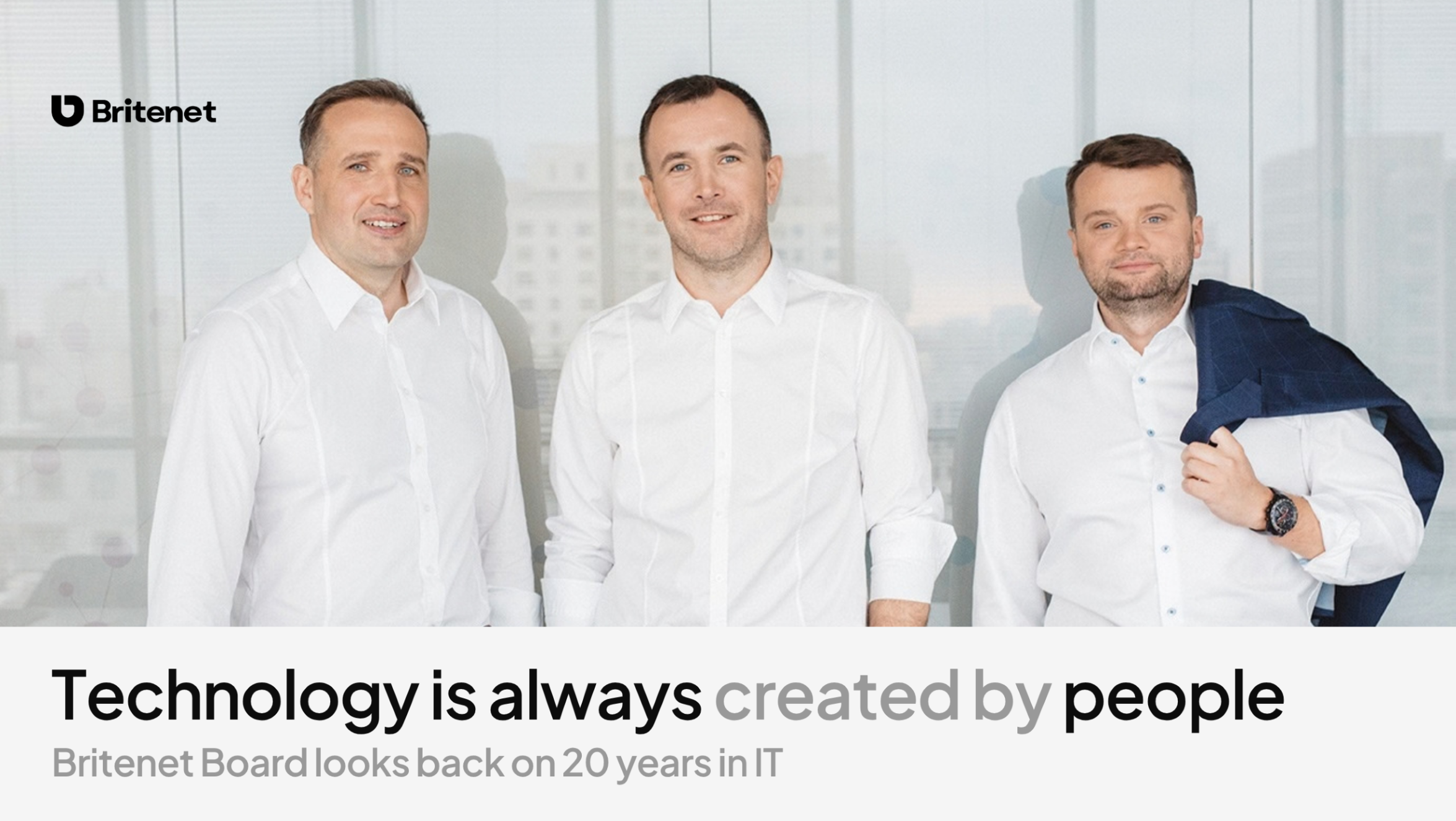
Two decades of operating in the IT market is a track record few companies can boast. To mark this occasion, we asked the people at the helm of Britenet – Michał Borny, Tomasz Krajewski, and Tomasz Dziki – about the valuable lessons they have taken from the past two decades, how they define responsibility for the team, and why the development of artificial intelligence hasn't stopped Britenet from being a "Human Company".
When you look back at Britenet's 20-year history, what is the first thought that comes to mind? Who are we really as a company after all this time?
Over these two decades, we have tried to be – and still try to be – first and foremost a solid IT company. And that is great, but when you decode all the processes, it turns out that at the foundation of our operations lies something entirely different. We are equally, or perhaps even more so, a so-called Human Company – a thoroughly human enterprise. Our business is simply services delivered by people for people.
Running such a business is no easy task. A human being is an incredibly complex, living organism, and building a company around them can be an extremely difficult challenge. However, it is precisely this human element that forms our entire foundation.
Michał Borny – CEO
The IT market and technology are changing at a frantic pace today. What makes Britenet still sail steadily across a rather rough sea after 20 years?
Indeed, the market sometimes resembles a stormy ocean – one moment a wave pushes you up, the next you get hit right in the face by a gale. What keeps us afloat and prevents us from capsizing is the commitment and professionalism of the people who make up our company.
I won't lie and say that we are the most brilliant people in the world, because no one will believe that. We are simply a group of very ambitious and hard-working individuals from this corner of the world, who still very much want to get things done, putting their heart and honesty into what they do. You can invent the most complex algorithms in the world, but without commitment, passion, and authenticity, you won't build anything lasting.
How much does Britenet from its early days differ from the organisation you manage today?
From today's perspective, there is no comparing us to who we were 5, 10, or 15 years ago. Back then, we operated in a much less organised way and learned from our own mistakes. Today, we are a much more mature organisation, with well-ordered processes and a clear structure.
Almost everything around us has changed, but that is a completely natural process. The most important thing is that the core of our crew has remained intact, and the new employees joining us bring fresh quality and strengthen this team. Continuously monitoring the quality of the human capital built up over the years is our most important task.
The next years of operation are ahead of us. What is your mindset looking at the future of the company and the industry?
In business, there is no such thing as retirement or a moment when you sit on the sofa and say the job is done. Competition has been, is, and always will be there. The world is rushing forward, people need new, better experiences, and market expectations grow every year.
This means that we, as a company and as people, must constantly prove ourselves and raise the bar. The key question for the future is: will we have enough creativity, perseverance, and energy to face the upcoming challenges? I deeply believe we will, because as long as there is energy, a willingness to cooperate, and mutual empathy within the organisation, we will handle any challenge.
Looking at Britenet's scale today and thinking back to 2006 – is there one lesson or business decision from those early years that best defined who you are in the market today?
In my opinion, there definitely wasn't one such decision. It's a matter of years, various situations, and continuously learning how to run a business. We made mistakes along the way, but we always tried to draw conclusions and make corrections. However, if I had to name one decision from those early years, it would be starting our cooperation with IGT (then Gtech Corp.) and building a remote work office for them.
Tomasz Krajewski – Board of Britenet
Probably the most important lesson was that in business, nothing is given forever. You can have a great team, good clients, a growing company, and make the right decisions for several years, but that doesn't mean the model that worked yesterday will work tomorrow.
Over 20 years, we had periods of very rapid growth, but also moments when we had to stop and admit that certain things required change. I suppose the ability to question your own past decisions is one of the hardest things to do, but it is an essential trait of a good leader.
I would tell today's leaders: don't get too attached to your successes, nor to your ideas. Attach yourself to the goal, and be ready to change the path leading to it.
Tomasz Dziki – Vice President of Britenet
With 20 years of experience behind us, we can see that the IT market is changing faster than ever. What business challenge are you entering the next two decades with, and in what direction is Britenet heading?
Definitely the hottest topic right now is the impact of AI. And not just on the IT industry, but on the whole world. Britenet must find its path in this new reality to better respond to market needs, which will undoubtedly keep changing. We have several open projects and are testing what will be most valuable to our clients. The basis of our operation is the need for continuous change and market observation, so it is hard to say now what the direction will be in, let's say, 2-3 years. Currently, the challenge is to make the best use of AI models so that they support people's work, whilst ensuring data security and confidentiality.
Twenty years ago, technological changes occurred much more slowly. Today, especially with the development of AI, they can undermine the assumptions upon which entire business models have been built for years in a matter of months.
Therefore, I don't believe the answer is trying to predict exactly what the IT industry will look like in five or ten years. We will probably get it wrong anyway. What's more important is building an organisation that can quickly spot a change, accept it, and adapt to it.
AI is a great example here. We can treat it as a threat to the traditional way of software development, or as a tool that will allow us to do things faster and better. We have no control over the fact that this change is happening. We do, however, have control over how we respond to it.
The IT industry has gone through a lot of turbulence over the last 20 years – from economic crises, through the outbreak of the pandemic, to the remote work boom. What is the lesson in maintaining business stability and continuity in difficult times?
You definitely have to watch your financial liquidity and operate on healthy margins. Diversifying the client portfolio is also important, as well as – to repeat what I said in the first question – the ability to continuously adapt and react to the changing market. You cannot offer the same thing for years without introducing any changes.
Over 20 years, I've learned above all that crises are a normal part of running a company. When we are in the middle of one, it always seems unique. In hindsight, it turns out to be just another stage.
The most important thing then is not to make decisions driven by panic. You have to look at the numbers, react quickly enough, but at the same time remember that the company also exists to take advantage of the moment when the situation starts to improve.
To me, stability does not mean a lack of change. Quite the opposite. Sometimes, in order for a company to remain stable, you have to have the courage to change a great deal.
Business relies on technology, but it is driven by people. How do you manage to maintain the spirit of a "community, not just a corporation" at your current scale of growth, and what does responsibility for the team mean to you in practice?
You have to be transparent and honest. Transparency, of course, doesn't mean a lack of confidentiality. Not all information can be announced because contracts prohibit it. However, we try to communicate all decisions, especially the difficult ones, in an open manner, and we answer questions if they arise. On the other hand, this is a business, not a nursery, so the company must be profitable, otherwise there is no point. For me, responsibility is first and foremost about fair treatment, which doesn't mean being overprotective.
Technology is our business, but Britenet has always been primarily a story of people. When a company grows to a thousand people, you cannot maintain exactly the same relationships as when everyone fit around one table. And I don't think there's any point in pretending otherwise.
You can, however, preserve something more important – the way we treat people. For me, responsibility doesn't mean promising that it will always be easy or that we will never have to make tough decisions. It means honesty, respect, and the awareness that real people are behind every business decision.
After 20 years, it is precisely the relationships that are one of my greatest sources of satisfaction. Results, projects, and technologies change. The people we've met along the way and what we've built together remain.
The history of Britenet's development shows that even in the most digitised world, people remain a company's most important capital, and their commitment and energy allow us to face any challenge.
We would like to thank all the employees, clients, and business partners who have been and continue to be a part of Britenet's history over the past 20 years. With such an experienced team and an open approach to technology, we eagerly look forward to the upcoming decades and business challenges.