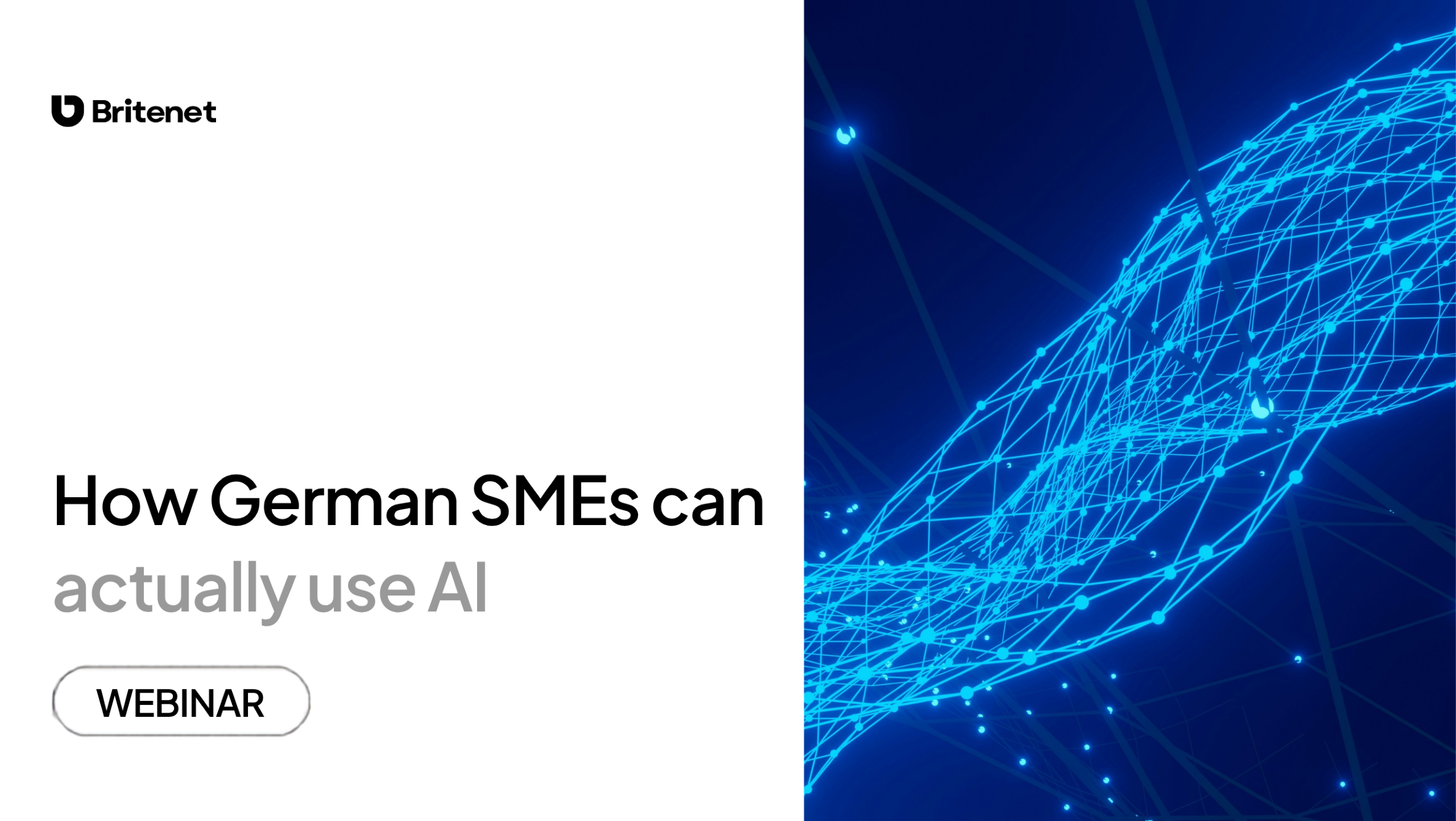
German small and medium businesses are feeling the squeeze. Labor shortages are hitting hard, the economy is rough, and daily operations keep grinding to a halt. To help bosses cut through the AI hype, Wirtschaftsförderung Mönchengladbach (WFMG), IT consultancy Britenet GmbH, and digital initiative NextMG hosted a webinar called "AI for SMEs: From Initial Ideas to Practical Implementation."
Jan Schnettler from WFMG hosted the session. He brought together three experts with very different takes on adopting AI: Benjamin Heuser (Digital Infrastructures Coordinator at WFMG), Björn Fuchs (AI Expert and Key Account Manager at Britenet), and Sebastian Leppert (Digital Entrepreneur and former NextMG Chairman).
Key takeaways from this article
- Huge interest, zero plan: About 87% of surveyed leaders think AI is crucial to relieve business pressure. But 80% of SMEs still don't have a documented AI strategy.
- Bosses need to step up: You can't just dump AI on your IT department. Leadership needs to own it and talk openly so workers don't panic.
- Bad data ruins everything: AI depends on clean data integration. Garbage in means garbage out. You've also got to watch your token costs.
- Keep your trade secrets safe: Don't throw private company data into public web tools. Use modular Large Language Models in private European data silos to respect GDPR and the EU AI Act.
- Think helpers, not replacements: Use AI as extra hands for your staff. Don't try to replace your whole team overnight.
Action beats master plans
A lot of SME bosses stall out because they think they need an exhaustive 200-page strategy before doing anything. But Benjamin Heuser showed that getting your hands dirty brings results way faster.
He shared how non-technical workers can use AI tools as personal digital tutors. They can handle tough jobs like querying geographic business data through Google Cloud Places APIs or digging into telecom case law. And they don't need a team of external developers to do it.
Instead of waiting around, leaders should set simple ground rules right away:
- Never put unprotected, sensitive data into public tools.
- Double-check AI output against real source documents.
- Be totally honest with clients when you use AI.
To build skills internally, regional programs like the skillsUP project in Mönchengladbach offer risk-free training for apprentices and junior staff. It turns them into internal "AI natives" who can upskill everyone else.
As Heuser put it: “Even a hands-on, pragmatic approach to AI is better than doing nothing... If you use it well, you get smarter! Precision is key.”
Getting real ROI: data, leadership, and token costs
Björn Fuchs brought up research from Ernst & Young showing that 87% of companies see AI as vital for efficiency, cutting costs, and filling labor gaps across production, customer service, and finance. But here's the thing. You shouldn't measure success by lab experiments. Success means putting active, working solutions into production.
Fuchs laid out five main pillars for getting real ROI:
- Fix your data first: Flawed data gives you flawed answers. Run a data check and use middleware to connect your messy systems.
- Top-down ownership: Bosses need to set the direction. It calms employee anxieties, which affect roughly 21% of the workforce.
- Control your token costs: LLMs charge based on tokens—the quantitative units of text you feed in and get back. Querying massive, unoptimized databases will make your bill skyrocket. Fast.
- Pick easy wins: Validate your setup with simple, high-impact pilot projects (Proofs of Concept) before touching core systems.
- Set rules early: Build in frameworks like the EU AI Act on day one. It saves you from costly rebuilds down the road.
Fuchs nailed it with this point: “AI will not lead the change – leaders will. Technology accelerates, but direction and trust remain human”.
Protecting your data and your people
Sebastian Leppert pointed out that AI isn't just an experiment anymore. It has moved straight into early business deployment.
But early adopters made a huge mistake: they tried to fire people right away. Take fintech firm Klarna. They replaced first-level support staff with AI, pissed off their customers, and had to hire human agents back. Leppert warned Mittelstand leaders not to fall into that trap. AI should give your current team extra bandwidth and absorb work as older workers retire. Don't throw away human expertise.
Privacy is another big hurdle. In a live poll, 23.08% of respondents named data privacy as their primary bottleneck. Don't feed trade secrets into general public tools. Instead, run modular, specialized AI engines inside private silos hosted on secure European servers or on-premise hardware.
Leppert stressed the core mindset: "The human being stands at the center, and capabilities are added to them through AI... Start small, keep models swappable, and remember: mindset comes before technology."
What Mittelstand leaders should do next
Ready to go from testing to scaling? Here is a strategic checklist for managing directors:
- Focus on the task, not the model: Choose specialized, right-sized models for specific jobs like tracking logistics or processing invoices. Don't burn cash on massive generalist models.
- Keep your tech flexible: Make sure the underlying LLM layer remains swappable within your software setup as the tech evolves.
- Train your people: In the webinar poll, 41.67% of executives said they would prioritize staff training if granted extra budget. Mix external advice with internal upskilling so you retain process knowledge in-house.
- Work with local partners: Reach out to local development agencies like WFMG, tech specialists like Britenet, and networks like NextMG. They can help run readiness checks, evaluate your data maturity, and plan safe pilot roadmaps.