At Britenet, we have been adopting an approach for years to technology that combines innovation with responsibility. In this way, we deliver measurable value to our clients, partners and internal teams. Today, AI helps us deliver projects faster, improves the quality of our analyses and boosts cost-efficiency – while remaining a tool to support specialists, rather than a solution designed to replace them.
That is why we have developed and implemented the Britenet AI Statement – a document that clearly sets out how we use artificial intelligence in our day-to-day work and the principles underpinning each process.
AI at the heart of modern IT processes
Artificial intelligence has become an integral part of our design, operational and technological activities. At Britenet, we view it as a tool that supports people in their day-to-day tasks – analysis, design and process optimisation. AI support enhances the precision of our work and speeds up its delivery, but it does not alter the fundamental principle – ultimately, responsibility, ethical considerations and quality control remain in human hands.
In this way, we combine the potential of technology with the knowledge and experience of our experts.
Clear rules and complete transparency
Our approach to AI is based on simple and clear principles. Artificial intelligence is designed to support and accelerate processes, but not to replace them entirely. Every use of AI is carried out in an ethical, controlled, and fully transparent manner.
We clearly identify where AI enhances our work. We use it, amongst others, for requirements analysis, document preparation, and to support technical processes such as design, testing, and code refactoring. Every result generated by AI is verified by specialists before it is used further.
Privacy and data security
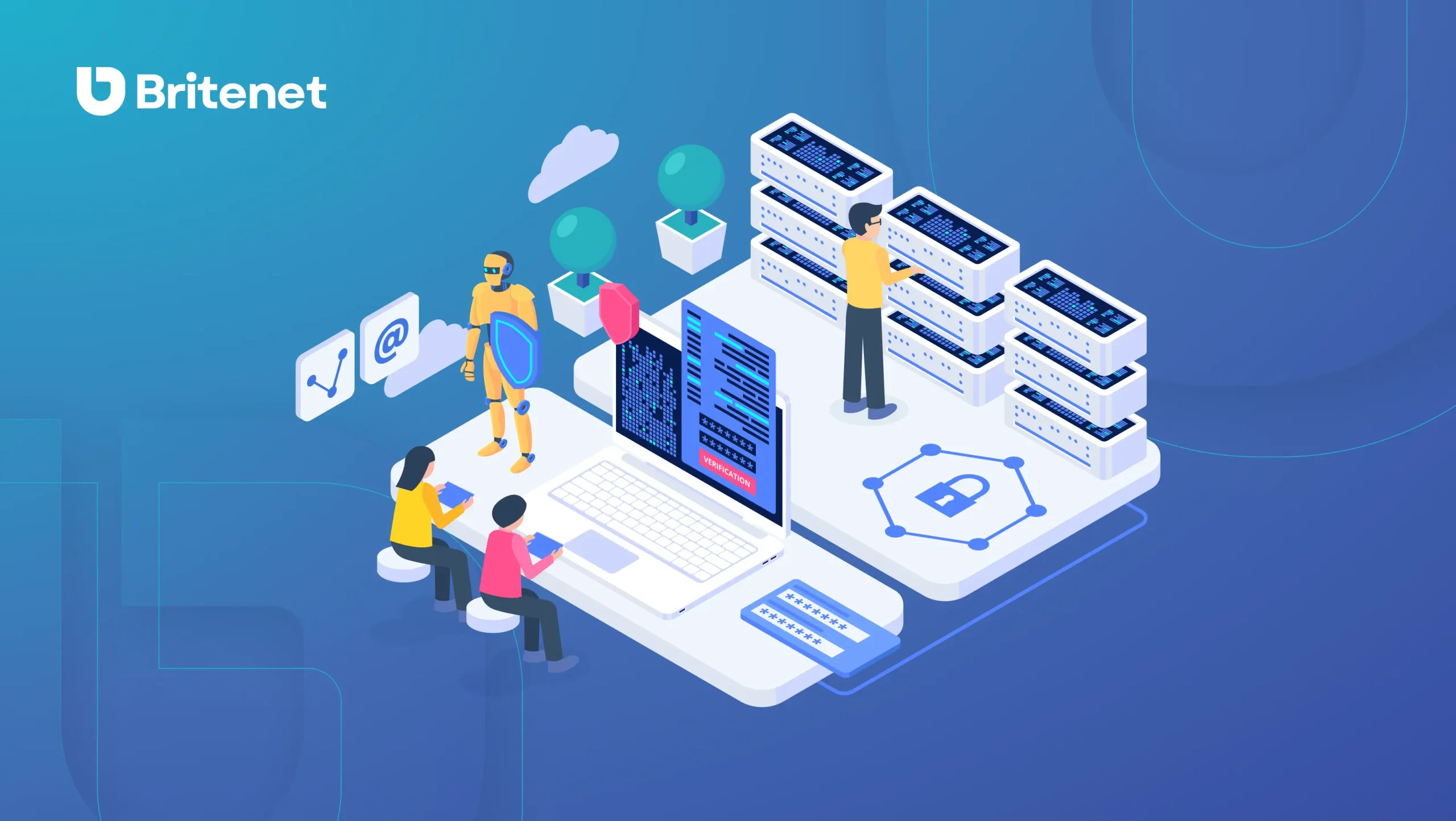
Data security is central to our approach to artificial intelligence. We use only enterprise-grade tools that are covered by appropriate data processing agreements (DPAs). We protect our clients’ and partners’ information at every stage of our work.
Client source code is not fed into AI systems without their explicit consent. Data identifying projects and clients is carefully anonymised before being used in AI tools, and any sensitive data – such as passwords, API keys, or other authentication details – is never shared with such tools.
For projects requiring the highest level of security, we use closed environments. All communication is encrypted, and access to data is granted in accordance with the principle of least privilege.
Human oversight of AI
At Britenet, artificial intelligence is designed to support the work of experts and entire teams. None of the tools make decisions, and every result generated by AI is verified by qualified experts. Depending on the process, we employ a multi-stage approach to quality control, including code reviews, automated testing, and expert reviews.
Responsibility for the outcome always lies with the people – Product Owners define the objectives, while Tech Leaders ensure the quality of the implementation.
Responsible development and regulatory compliance
We view the development of AI as a process that must comply with applicable regulations and industry standards. That is why we are introducing mandatory training on AI security for all technical staff, and we regularly conduct audits of the use of AI tools within the company.
We work exclusively with suppliers who meet data security and protection requirements, and our operations comply with European regulations – including the AI Act and ISO/IEC 42001 standards.
Continuous improvement of our approach to AI
Artificial intelligence and the relevant regulatory framework are evolving rapidly. At Britenet, we are constantly adapting our processes to ensure we remain in line with industry best practice.
Our staff regularly enhance their skills in the areas of safety, ethics, and the responsible use of AI. We view technological development as a means of supporting our clients and teams more effectively. AI enables us to work faster, deliver higher quality, and create more innovative solutions, while always maintaining human oversight and ethical responsibility.